
Sketch Artist: Heather Rodriguez, FIU College of Communication, Architecture and the Arts
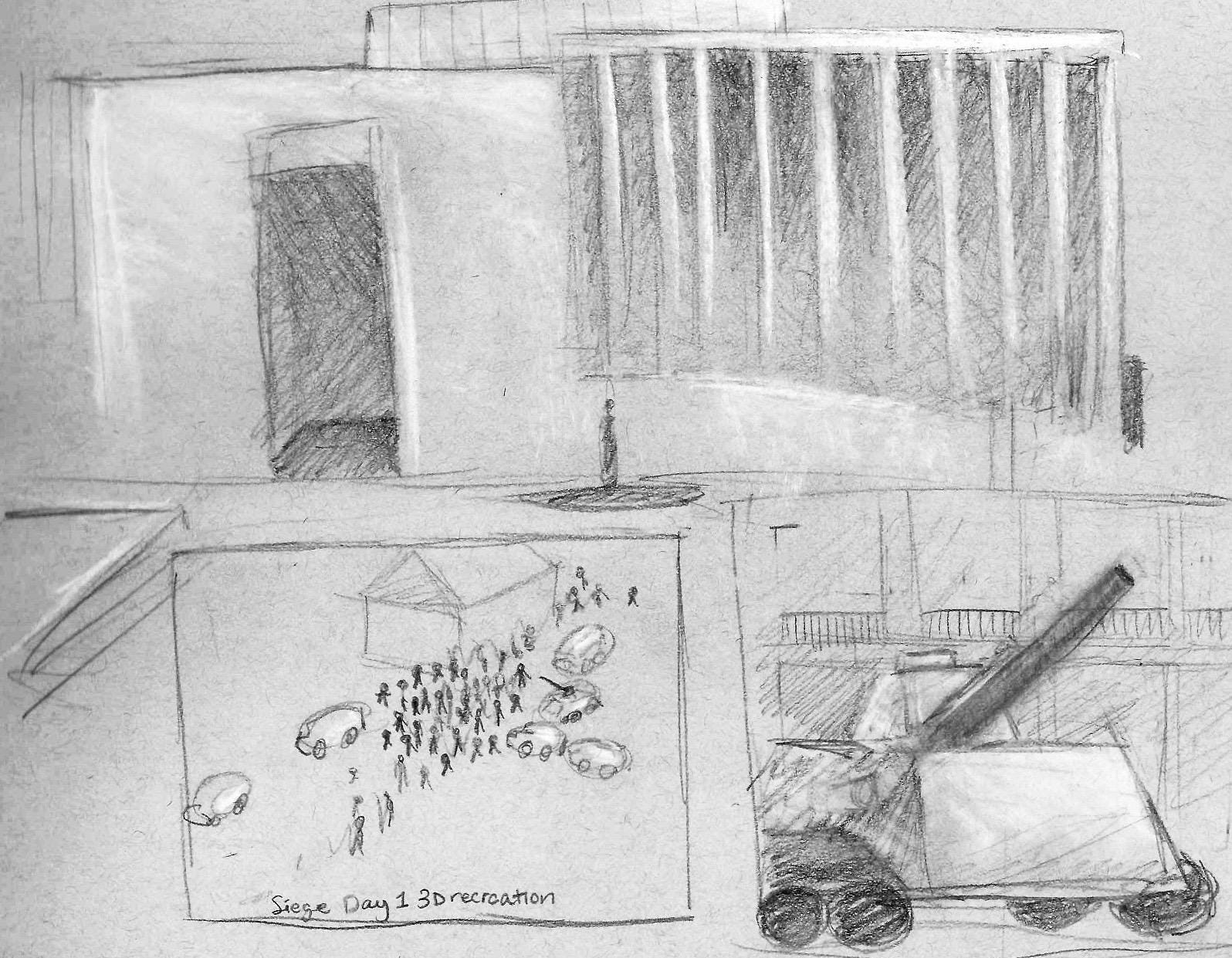
The fourth day of trial in Urán v. Plazas Vega began on a rainy, thundering Miami morning. Even so, counsel for both sides and the jury were ready by 9:00 a.m. The day’s testimony covered the defense’s cross-examination of Ricardo Gámez Mazuera, a former informant for Colombian police and military intelligence, and the direct examination of Dr. Hannah Martin, an expert witness who helped reconstruct the siege of the Palace of Justice through three-dimensional modeling and synchronized audiovisual evidence. Together, the witnesses moved the jury from a contested personal account of military intelligence operations to a visual and acoustic reconstruction of the siege and the movement of people who left the Palace alive.
The Cross-Examination of Ricardo Gámez Mazuera
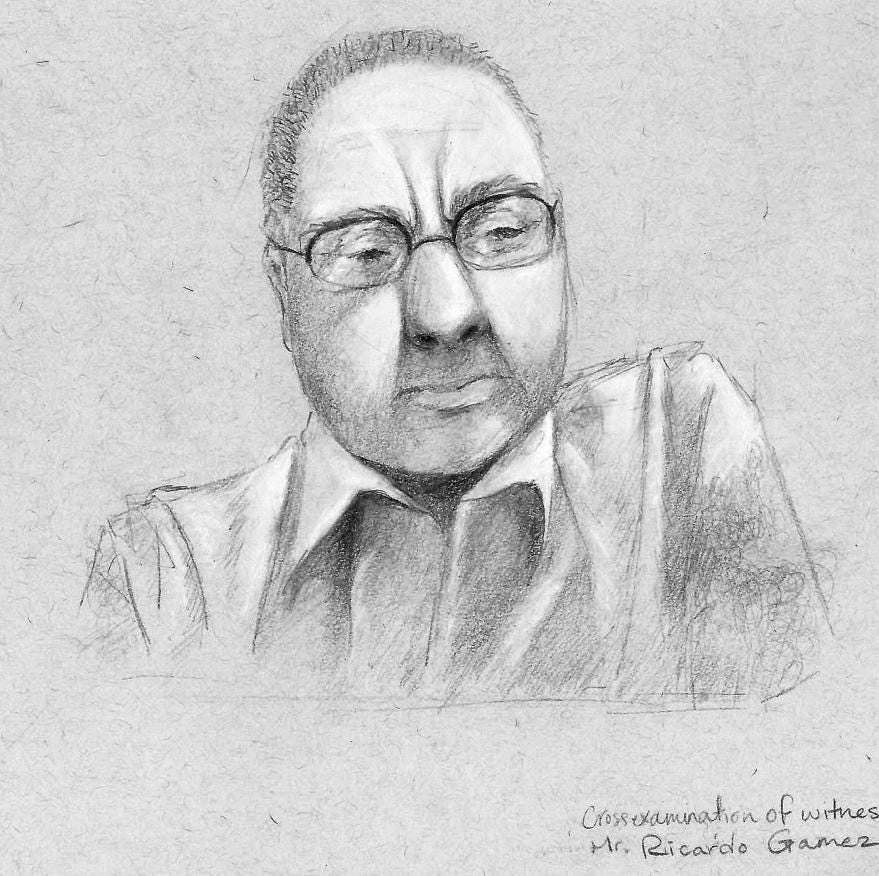
At approximately 9:15 a.m., Gámez’s recorded deposition resumed from the previous day. Because the video had glitched near the end of the Plaintiffs’ questioning, Plaintiff’s counsel replayed the final portion of direct testimony. Gámez concluded that portion of his testimony by stating that the Army had sectioned off people after the siege. Defense counsel then began the cross-examination, quickly focusing on Gámez’s intelligence background, the unofficial nature of his work, and the absence of records or witnesses to corroborate his account.
Sketch Artist: Heather Rodriguez, FIU College of Communication, Architecture and the Arts
An Unofficial Informant
Gámez maintained that he had served as an auxiliary officer with the Colombian National Police and performed the duties of a regular patrol officer. His police service stemmed from Colombia’s mandatory service system. He attended police training, served at several stations, and left the auxiliary police in approximately 1978, after about two years.
He also described an accusation of desertion after he took approximately five days of unauthorized leave. Gámez said he was ultimately acquitted because officials had wrongfully recruited him despite a partial disability affecting his arm. He referred to photographs of himself in uniform and a certificate of good standing issued by a military or war council in Bogotá. Before and after his police service, Gámez said, he worked as an unofficial informant for Colombian police and Army intelligence. There was no formal course or fixed standard for informant work. Gámez did not attend college and described learning intelligence work ‘in the streets,’ although he received informal advice. He testified that he worked in intelligence for roughly ten years and traveled throughout Colombia. He identified DIJIN, SIJIN, S-2, B-2, and M-2 among the entities or units with which he worked. He described B-2 as a general or central Army intelligence service and M-2 as an intelligence service involving high-ranking officials. He also referred to the Army Artillery School, Military Police Battalion No. 1, the Cavalry School, and other intelligence units in Bogotá.
Gámez testified that he gathered information about illegal weapons sales, clandestine meetings, narcotics, urban guerrillas, suspected M-19 members, and general law-and-order matters in Bogotá. He described repeated stakeouts aimed at identifying suspected guerrillas and learning their methods of operation before reporting the information to S-2 or B-2. He believed the military would then conduct additional surveillance and make arrests.
The defense pressed Gámez on what it meant to be an unofficial informant. He carried no badge or identification, received no pay stubs or timesheets, and left no official record of his assignments. He gave information only to the officer who requested it and did not discuss his missions with family or friends. Gámez explained that intelligence officers often used aliases or call signs, including a name recorded as Captain Luz or Lux, so he frequently did not know their legal names. He could identify rank from uniforms, but he could not name high-ranking officers who might corroborate his account. The defense repeatedly returned to this lack of documentation and identifiable witnesses as it challenged his credibility.
The Morning of the Siege
Turning to November 6, 1985, Gámez testified that he and another person were instructed to conduct a sweep near the Palace of Justice while dressed in civilian clothing. They walked through or near Santander Park toward the Capitol, looking for unusual activity, including trucks or buses that did not belong in the area. Other police and military intelligence personnel, including SIJIN and B-2 personnel, were also monitoring the area.
The Presidential Guard or Presidential Brigade was described as the first security force to arrive and close the road. Gámez said he was initially denied entry to Casa del Florero but later gained access because personnel recognized him and because he knew a coded exchange. When asked where he was coming from, he would answer, “From the mountains.” He said he used the phrase only once or twice before becoming a familiar face. Although he did not carry a walkie-talkie, he overheard official communications and sometimes inferred speakers’ call signs from context. He could not always determine who was speaking or giving an order.
Gámez observed military and intelligence vehicles from different units near Casa del Florero. He testified that people leaving the Palace were taken to the second floor of Casa del Florero and that some were placed in vehicles and transported elsewhere. He recalled that personnel in the area wore khaki-colored uniforms.
The Acid and Quicklime Testimony
One of the most striking portions of Gámez’s account concerned a military truck he claimed to have boarded while traveling to receive payment. As he prepared to climb into the truck bed, the driver warned him that acid was stored in the back and told him to sit in front. Gámez described seeing three or four containers of what he understood to be sulfuric acid, although they bore no identifying markings, as well as four or five sacks or quantities of quicklime. He testified that sulfuric acid and quicklime could be used in an old practice to eliminate traces of dead bodies, which he described as making people disappear.
The destination of the materials became the clearest impeachment evidence for the defense. During the present deposition, Gámez said the truck went to the Cavalry School and that the materials were unloaded there. Defense counsel then played a recording of a 1989 statement in which he reportedly said the materials were taken to the Artillery School and that he did not go to the Cavalry School. When confronted with the different locations, Gámez attributed the inconsistency to a lapse in memory and a linguistic lapse. He further explained that he had gone from the Artillery School to the Cavalry School.
Security and Corroboration
The deposition also became tense when defense counsel asked where Gámez had met with plaintiffs’ counsel. Gámez testified that he met with counsel once for approximately 45 minutes to 1 hour to discuss his willingness to provide a statement and to prepare for the deposition. He refused to disclose the location because of concerns for his and his family’s safety.
Defense counsel continued to ask why he would not identify the location and whether he or his family had ever been threatened. Gámez replied, “I haven’t given them the opportunity and won’t start today.” The jury appeared attentive during the recorded exchange.
When defense counsel asked for evidence or witnesses to verify his intelligence work, Gámez again referred to his photographs and certificate of good standing. Beyond those materials, which were not presented in court during this testimony, he maintained that unofficial informant work was not, by its nature, documented. He also believed that anyone who remembered him would be reluctant to become involved because of the whistleblower statement he gave in 1989.
Gámez further testified that he saw the defendant, Luis Alfonso Plazas Vega, a retired colonel of the Colombian Army who in November 1985 was the lieutenant colonel commanding the 13th Brigade’s Cavalry School, at Casa del Florero and heard him direct that an unidentified person be taken from, or to, the café “to be worked.” The exact phrasing and direction were unclear in the notes. Gámez said, but the statement remained in his memory because he wondered what it meant. He acknowledged, however, that he never heard Plazas Vega expressly order anyone to be disappeared. The defense’s cross-examination ended at approximately 10:40 a.m., and the jury left for a short break.
The Reconstruction of the Palace of Justice Siege: Dr. Hannah Meszaros Martin’s Testimony
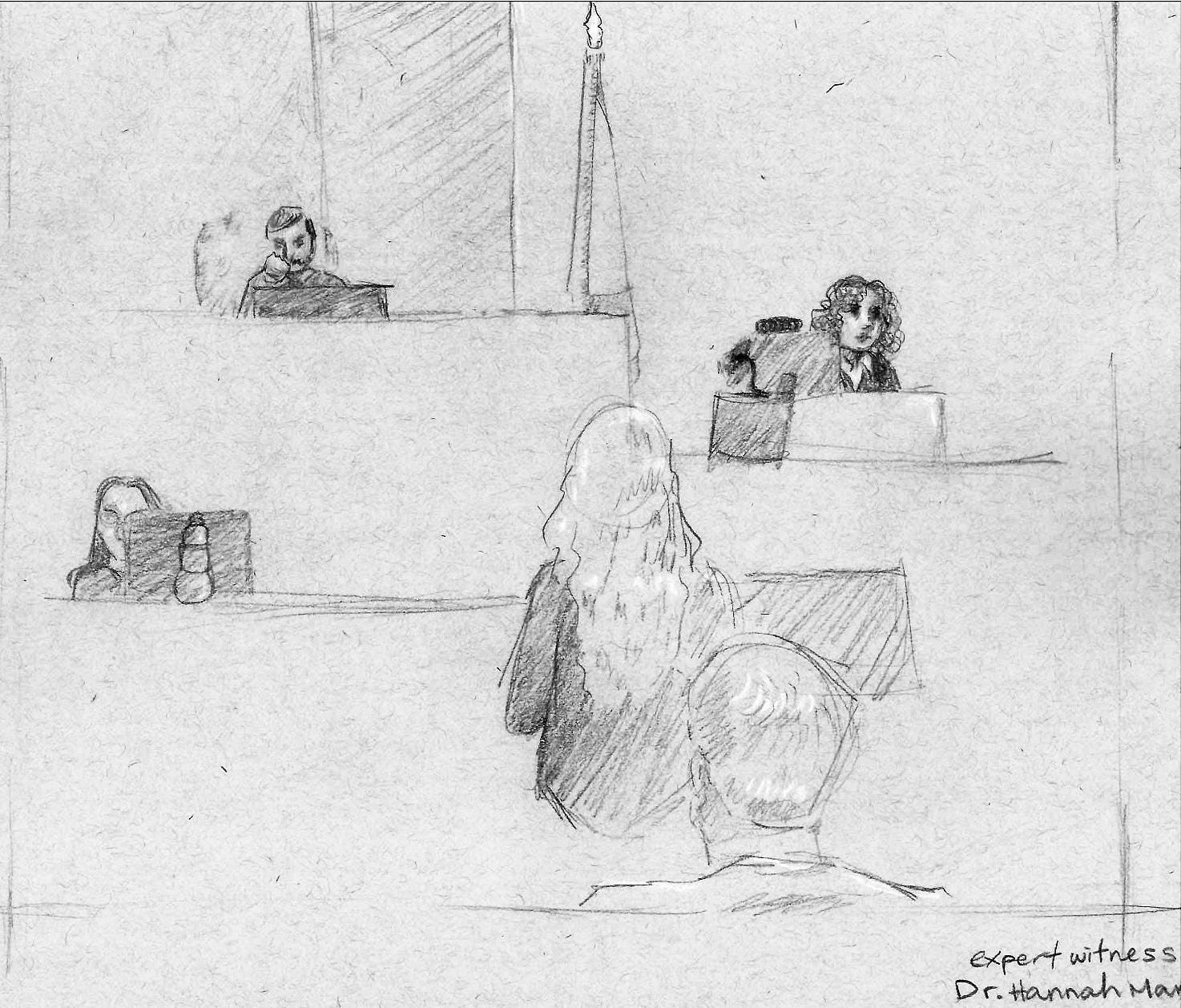
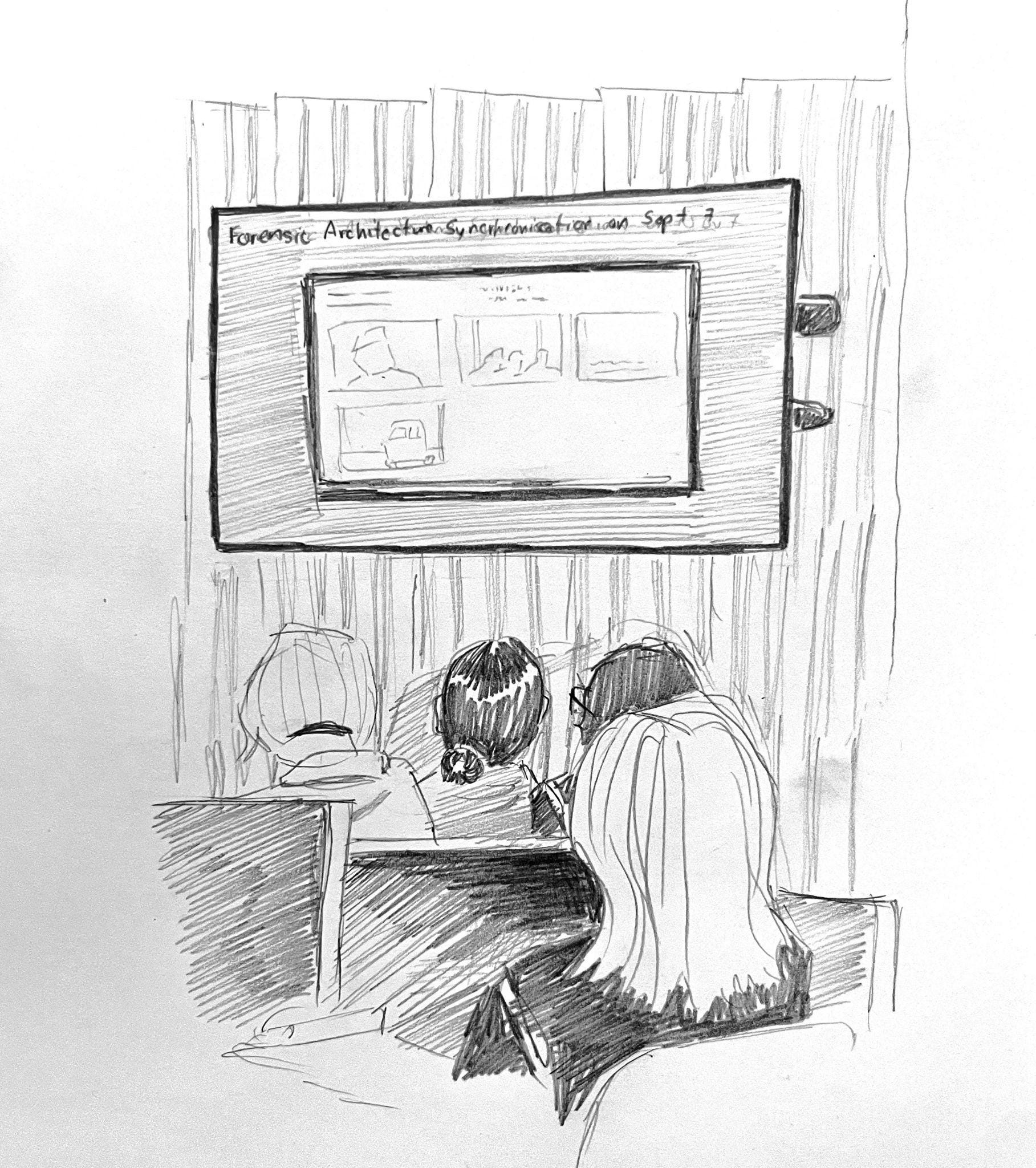
The jury returned shortly after 11:00 a.m., and plaintiffs’ counsel called Dr. Hannah Martin, who testified in person as an expert in audiovisual and spatial forensic analysis. Dr. Martin holds a doctorate and is a research fellow with Forensic Architecture, an internationally renowned visual investigation agency based at Goldsmiths, University of London. Forensic Architecture has collaborated with the Colombian Truth Commission since 2018.
Sketch Artist: Heather Rodriguez, FIU College of Communication, Architecture and the Arts
Dr. Martin explained that Forensic Architecture uses videos, photographs, witness statements, architectural plans, audio recordings, and three-dimensional models to reconstruct incidents of violence. Demonstrative slides and synchronized media accompanied her testimony.
Building the Reconstruction
Dr. Martin testified that Forensic Architecture’s Palace of Justice project began around 2019 and was completed in December 2021. Working with the Colombian Truth Commission, the team obtained architectural plans, photographs, videos, witness statements, military radio recordings, military documents, and materials from legal proceedings. It also requested raw footage from broadcasters and reviewed more than 50 hours of audiovisual evidence.
Dr. Martin described five stages of the investigation: (1) collecting video; (2) conducting audiovisual and spatial analysis; (3) obtaining situated testimony; (4) synchronizing recordings; and (5) examining each video’s history as an evidentiary object. The team traced materials to their sources, studied military documents and DNA analysis, and used radio communications to build a timeline. Witnesses were placed within three-dimensional models and asked to reconstruct their movements and observations. Because the Palace of Justice was destroyed, architectural plans and historical photographs were essential to rebuilding the space to scale.
The final work included films, synchronized audiovisual timelines, an evidence grid, and three-dimensional models of Plaza de Bolívar, Casa del Florero, the Cavalry School, Cantón Norte, and nearby landmarks. The Plaza de Bolívar model included the Palace of Justice, the cathedral, the presidential palace, the mayor’s office, surrounding streets, the military security cordon, vehicles, and camera positions. The Casa del Florero model incorporated architectural plans and witness accounts of where people were registered, questioned, and moved.
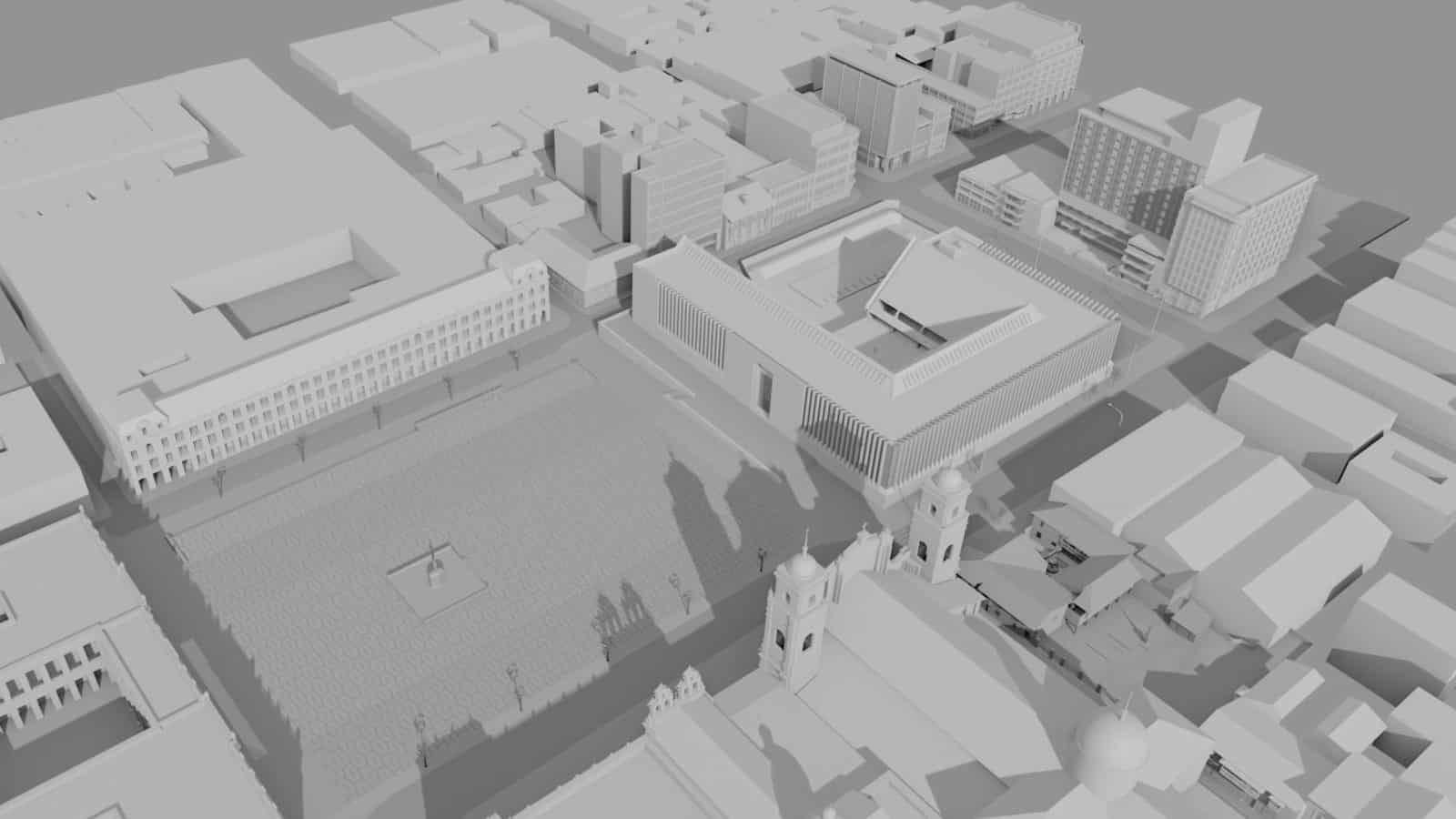
3D model of the Palace of Justice and Plaza de Bolívar. Image: Forensic Architecture, The Black Boxes of Disappearance: Enforced Disappearance in the Siege of the Palace of Justice (2021), forensic-architecture.org
Synchronizing What the Jury Could See and Hear
Dr. Martin demonstrated software that aligned multiple audio and video tracks. Shared sounds made it possible to synchronize footage recorded from different camera positions. Visible clocks, spoken references to time, military radio transmissions, camera locations, and the movement of people through the scene helped the team establish chronology, even though the aging footage generally lacked embedded timestamps. Dr. Martin and Forensic Architecture used voice samples supplied by the Truth Commission and self-identification to connect radio communications with people or events shown in news footage.
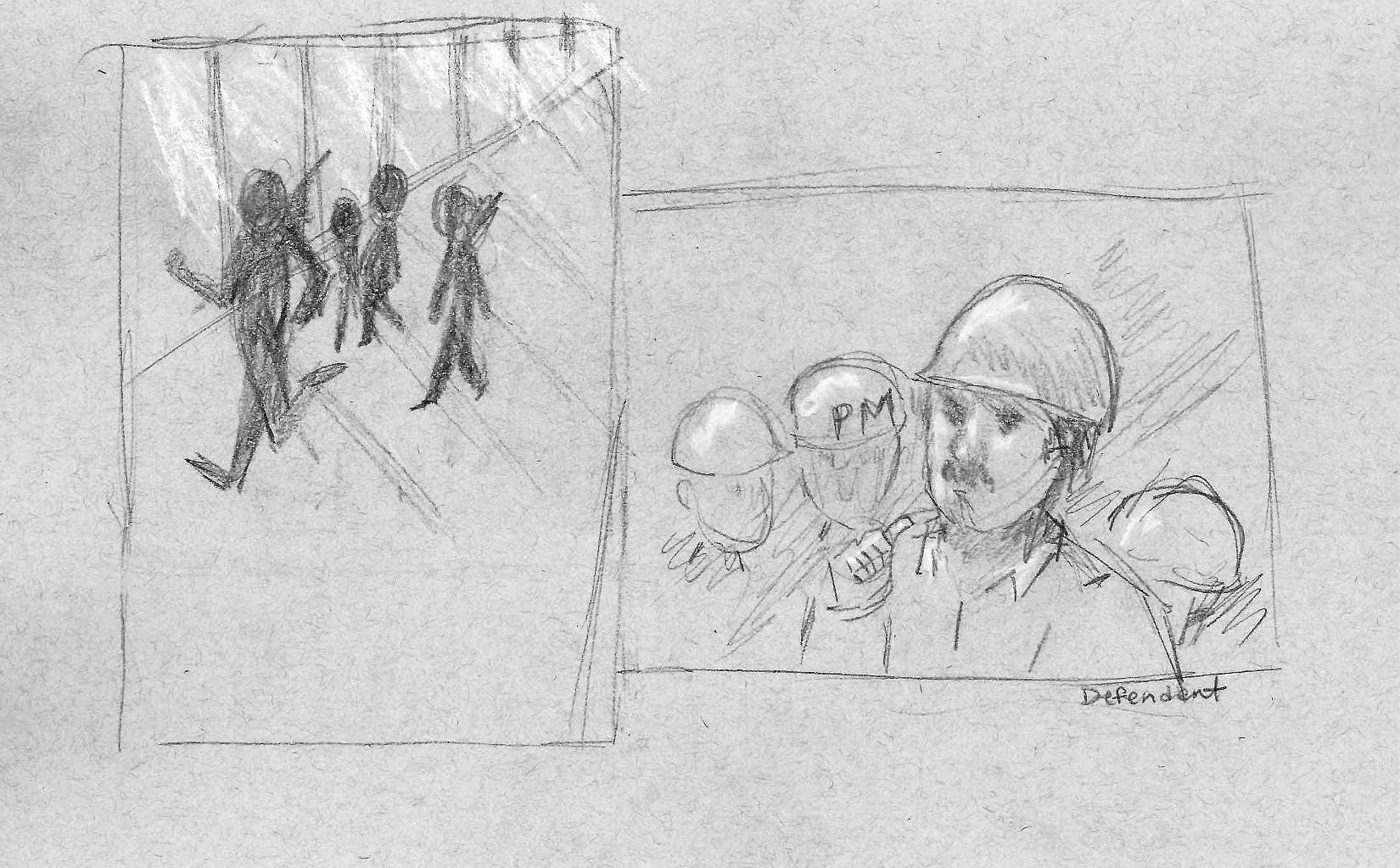
This methodology was designed to transform dispersed archival material into a reconstruction of the siege that could be seen and heard. One synchronized sequence showed Plazas Vega, wearing a helmet and with his distinctive mustache, walking along Calle Once near Casa del Florero, surrounded by journalists. Other footage showed hostages and military personnel leaving the Palace in single file from multiple camera angles. Some individuals appeared with their hands behind their backs. A military transmission reportedly relayed information from Magistrate Urán’s wife concerning his location inside the building.
Tracing Those Who Left the Palace Alive
The project focused on tracing people who emerged from the Palace alive, including individuals classified as “especiales.” The investigators began with people who had already been identified and matched photographs and video across time and location. They examined raw footage of vehicles, security forces, and evacuees, including whether individuals were pulled by the arm, held in line, or escorted at gunpoint. Dr. Martin compared military documents describing procedures for handling people considered suspicious with witness testimony and the visual record.
Dr. Martin testified that after the siege, the military blocked off one of the nearby streets to set up a security cordon. This was done for two reasons: 1) to control evacuees, ensuring they do not escape; and 2) to identify and categorize those leaving the Palace. Security personnel consulted identification materials as evacuees passed through. In accompanying radio communications, military personnel expressed concern that guerrilla members might leave in civilian clothing. Dr. Martin explained that these communications indicated that information was being received from inside the Palace.
Dr. Martin identified Luz María Portela León as one of the first people shown in the video leaving the Palace and as a person who was later disappeared. When the defense objected on relevance grounds, Judge Ruiz overruled the objection.
After lunch, Dr. Martin’s testimony then turned to a series of photographs, videos, and audio recordings that Dr. Martin described as central to the Forensic Architecture reconstruction — several of which have become part of Colombian historical memory. Dr. Martin emphasized the importance of timestamps on this documentary evidence, tying each piece back to the synchronization methods and models she had described earlier, and the jury appeared closely focused as several of the videos played.
Footage from the Evening of November 6
Dr. Martin first showed footage of security forces positioned in front of Casa del Florero, with individuals lined up against the walls. She noted that some of those visible in the frame appeared to be journalists, identifiable by the cameras they carried. A second clip showed people being funneled through the doors of Casa del Florero, with a woman near the back of the frame appearing to hand something to a man in uniform. This was the footage Orlando Arrechea had identified himself in to Dr. Martin. Additional footage from Seventh Avenue showed an army member searching an individual, which Dr. Martin offered as an example of journalists attempting to film along Seventh Avenue being pushed back by the military.
Dr. Martin then played footage from the evening of November 6 depicting Plazas Vega, which she said her team had used to synchronize the video. In it, Plazas Vega described the situation inside the Palace of Justice as he understood it at the time, stating that the commander of the 13th Brigade was directing operations from within. He said there had been casualties, mostly among M-19 members, that resistance continued on the second and third floors, and that there was one civilian casualty. Dr. Martin explained that her team built its video synchronization from footage recovered from both November 6 and November 7.
Footage from November 7
Turning to the following day, Dr. Martin showed security footage of people being escorted quickly between two lines of armed men into Casa del Florero. Some of the armed men in the footage wore civilian clothing, which Dr. Martin identified as Colombian intelligence personnel based on armbands she said were characteristic of agents from that period.
A radio recording captured a conversation involving someone identified in the recording as “Azbache 6,” whom Dr. Martin identified as Plazas Vega, discussing the transfer of rescued hostages from the Palace of Justice to a location referred to as “the dispensary.”
Separate footage showed a magistrate exiting the Palace of Justice and walking to the corner of 11th Street and Seventh Avenue, where he entered Casa del Florero accompanied by a soldier. Dr. Martin testified that this supported her expert opinion that Casa del Florero was used to screen rescued hostages as they emerged.
Sketch Artist: Maredy Narea, FIU College of Communication, Architecture and the Arts
Radio Traffic and Named Officers
Several radio recordings featured officers identified by call sign. One recording captured a conversation between a person identified as “Arcano 6”, in which Arcano 6 discussed injured individuals. A separate recording featured “Arcano 5” in conversation with “Arcano 6” about Carlos Martínez, the head of the Red Cross. Later testimony identified “Arcano 6” specifically as General Jesús Armando Arias Cabrales. Dr. Martin said these recordings supported her broader conclusion that the clothing individuals wore during the evacuation influenced how the military categorized them.
Dr. Martin testified that of all the individuals identified across the gathered footage, Plazas Vega appeared more often than anyone else.
Vehicles, Categorization, and the RCN Broadcast
One video, which Dr. Martin’s team used to track vehicle movements, showed a group of people inside a vehicle whom she said her team had come to understand — based on witness testimony — as individuals categorized as “especiales.” A radio recording from November 7 captured a conversation in which the leader of an M-19 group was said to be carrying a fake identification; Dr. Martin testified that recordings of this kind supported her conclusion that the hostage-rescue process was designed to identify individuals as they came through.
An RCN broadcast, drawn from material the Truth Commission had provided, captured a conversation between an RCN reporter and Plazas Vega regarding the situation as of approximately 11:00 a.m. on November 7, in which Plazas Vega stated that guerrillas were dressed as police officers or in civilian clothes.
Afternoon Footage of November 7
Dr. Martin spent a part of her afternoon testimony discussing her team’s tracing of Plazas Vega. Additional footage from the afternoon of November 7 showed Plazas Vega speaking with military personnel, apparently filmed on 11th Street while he was leaving Casa del Florero. Separate footage, sourced from a Spanish news station, showed Plazas Vega at 2:22 p.m., roughly two minutes after the last wave of hostages had emerged. Another clip depicted tanks that Dr. Martin said would have been positioned in front of the cathedral, and again identified Plazas Vega speaking with military personnel. A further piece of footage, Dr. Martin acknowledged, showed Plazas Vega but could not be placed within the established timeline of events.
Tracing the Van and the Cavalry School
Dr. Martin then presented a second film her team had produced, which focused on tracking a vehicle referred to as “la camioneta” and showed people being removed from Casa del Florero and placed into vans as the team attempted to identify them. The team traced the van’s route along 11th Street toward Cantón Norte and the Cavalry School.
Dr. Martin’s team also built a three-dimensional model of the Cavalry School, highlighting in white the buildings that witnesses testified they had been taken to during the events at the Palace of Justice, and including a close-up of the stables, consistent with testimony from individuals who said they had been held there.
Sketch Artist: Heather Rodriguez, FIU College of Communication, Architecture and The Arts
Tracing Individual Trajectories, Including Urán’s
Dr. Martin’s team also tracked the individual paths of several people who left the Palace of Justice, including a person she identified as Magistrate Urán. Using synchronized footage, the team reconstructed his being carried from the Palace of Justice on a stretcher to 11th Street. Dr. Martin cautioned, however, that it remained unclear from the available footage whether he was then taken into Casa del Florero or placed in an ambulance stationed near the entrance. Magistrate Urán’s body was later found inside the Palace of Justice.
By the close of the day, the jury had heard two very different forms of evidence. Gámez offered a personal account built on undocumented, informal intelligence work, and his testimony represented the limits of memory after four decades. Dr. Martin presented a methodology for testing the surviving record across time and space. Her synchronized footage and three-dimensional models offered the jury a structured way to examine who left the Palace alive, how military forces processed them, and what the archival record can still reveal.